Commercial Solar Systems in Geelong & Regional Victoria
Commercial solar installation for business across regional Victoria


Solar for Business
Your Business Runs During the Most Expensive Hours
Most businesses use the bulk of their electricity during the day, right when grid rates are at their peak. That's actually the best possible scenario for solar. Every kilowatt your system generates goes straight to offsetting the power you'd otherwise buy at full retail rate.
Commercial clients are financially motivated, and rightly so. This isn't about environmental credentials on a brochure. It's about reducing your largest variable operating cost, year after year, with an asset that depreciates in your favour.
As an EPC (Engineering, Procurement and Construction) provider, we coordinate the full delivery process, from energy analysis and electrical engineering through procurement, installation, and commissioning. We work with structural and electrical engineers to make sure the system is fit for purpose, and we coordinate with the relevant network providers to ensure everything meets ESV, Clean Energy Council, and SAA requirements.

What's Different
This Isn't a Residential Install on a Bigger Roof
Commercial solar involves engineering, compliance, and coordination that simply doesn't apply to homes. Even a 30 kW system on a cafe or medical centre needs three-phase design, DNSP coordination, and proper structural assessment. You need an installer who understands commercial power, not a residential crew working on a bigger roof.
Structural Assessment
We work with structural engineers to verify wind and weight loading for your building. Every commercial roof is different. Flat, pitched, metal, concrete: assumptions don't cut it when you're mounting hundreds of kilos of panels and racking.
Three-Phase & Protection Design
Commercial systems need proper electrical engineering, including protection boards, export limit assessments, and grid protection designs. We coordinate this with qualified electrical engineers to meet ESV, CEC, and network provider requirements.
Working Around Your Business
We schedule every phase of the install around your operations. If a switchboard shutdown needs to happen early morning or on a weekend to avoid disrupting your customers, that's what we do.
DNSP Coordination
We coordinate directly with your local distribution network service provider to manage grid connection, export requirements, and all the paperwork. This is a process we handle entirely, so you don't need to deal with it.
Who We Serve
Commercial Solar Across Regional Victoria's Key Industries
We design and install for businesses right across the region, with particular experience in:
Whatever your load profile, we size the system to how your site actually uses power.
System Types
What We Design and Install
Rooftop Systems
From 30 kW to 100+ kW, designed for flat or pitched commercial roofs. Engineered mounting with verified wind and weight loading for your specific building.
Ground Mount
For properties with available land or roofs that aren't suitable. Engineered foundations with optimal tilt and orientation for maximum generation.
Three Phase
Designed for commercial electrical infrastructure. Full monitoring, export management, and reporting to track your return from day one.
Commercial Rebates
STCs Up to 1 MW, LGCs Above That
Small-scale Technology Certificates (STCs) are the upfront discount most people call the solar rebate. Your installer creates the certificates, sells them, and the value comes straight off your quote. Until now they have only applied to systems up to 100kW. On 5 August 2026 the federal government announced it will lift that ceiling to 1MW for systems installed from 1 October 2026, subject to regulations being finalised, with an estimated 20 per cent off the upfront cost of an eligible system.
Above that threshold, systems create Large-scale Generation Certificates (LGCs) instead. There is no discount on the invoice. LGCs are earned each year on the electricity your system actually generates, then sold or traded, so the return has to be modelled rather than assumed.
We handle the certificate process for you, whichever scheme your system falls under, managing the paperwork and making sure you receive the full value you're entitled to. Combined with tax depreciation on the system itself, the financial case for commercial solar is strong.

Victorian and Federal Rebates
There is more than one rebate on the table
Most businesses assume there is a single solar rebate. In Victoria there are several, they come from different governments, and more than one can apply to the same system. Two of them changed in the last twelve months.
Victorian Energy Upgrades
A Victorian rebate for commercial and industrial solar between 30kW and 200kW, paid as an upfront discount at installation rather than claimed back later. Running since September 2025.
Small-Scale Certificates
The federal upfront rebate, taken straight off your quote. Currently available up to 100kW, expanding to 1MW for systems installed from 1 October 2026, subject to regulations.
Large-Scale Certificates
For systems above the small-scale threshold. Rather than a discount on the invoice, these are created each year against the electricity your system actually generates, then sold or traded.
Battery Rebate
Despite the name, the Cheaper Home Batteries Program is open to businesses as well as households, for systems from 5kWh to 100kWh. The rate changed on 1 May 2026 and steps down over time.
Returns
The Financial Case
Direct Retail Rate Savings
Every kilowatt of solar you use directly offsets power you'd otherwise buy at full commercial rates. Daytime businesses such as cafes, medical centres, and retail see the fastest payback.
Certificate Rebates
STCs come straight off your quote, currently up to 100kW and rising to 1MW for systems installed from 1 October 2026, subject to regulations. Larger systems create LGCs on actual generation. <strong>We manage the entire process.</strong>
Tax Depreciation
Your solar system counts as a business asset. Your accountant can depreciate it under Division 40 to lower your taxable income each year. It's a genuine write-off that improves the payback.
Financing Options
Pay outright (CapEx) for maximum long-term savings, finance with zero upfront cost, or explore a Power Purchase Agreement for larger systems. <a href="/services/commercial">See all financing options</a>.
Builders & Architects
We Work Alongside High-End Builders and Architectural Firms
We have long-standing relationships with quality builders and architects, integrating our work into every stage of the build. Because we work to the builder's timeline, we get every cable and conduit hidden before the plastering stage, while scaffold and edge protection are still up, for the neatest possible finish and no cost to retrofit solar and battery infrastructure once the build is complete.
Pre-Wire
Cabling and conduit run and concealed before lining, mapped to the electrical and roof plan so nothing is left exposed later in the build.
Solar Panel Laying
Mounting and array installation scheduled to the build program and coordinated with roofing and the other trades working on site.
Inverter & Battery Commissioning
Inverters and battery storage set up and tested in sequence, ready for connection as the build reaches lock-up.
Site Energisation & Commissioning
Third-stage energisation, final testing and handover, delivered on time so it never holds up practical completion.

Compliance
Standards & Accreditation
Even a smaller commercial system needs to meet the same Australian electrical and energy standards as a large-scale install. We ensure every system complies with:
Our Process
From Site Assessment to Savings
We evaluate your property, energy usage, electrical infrastructure, and roof suitability. We look at your bills, your operating hours, and your lease situation to make sure the numbers work for you.
Engineered for your specific load profile, building layout, and export requirements. Electrical engineers prepare protection schematics where required.
We handle grid connection applications, DNSP coordination, permits, STC or LGC paperwork, and any council requirements. You don't need to chase any of this.
Scheduled entirely around your operations. Early mornings, weekends, whatever minimises disruption to your business and your customers.
Full system testing, monitoring setup, and handover. Every system is monitored from day one so we can track performance and respond to any issues.
Extend Your Savings
Add Battery Storage
Solar covers your daytime consumption. A battery extends those savings into peak tariff periods and reduces demand charges, which for many businesses are the single biggest line item on the electricity bill.
Learn About Commercial Battery Storage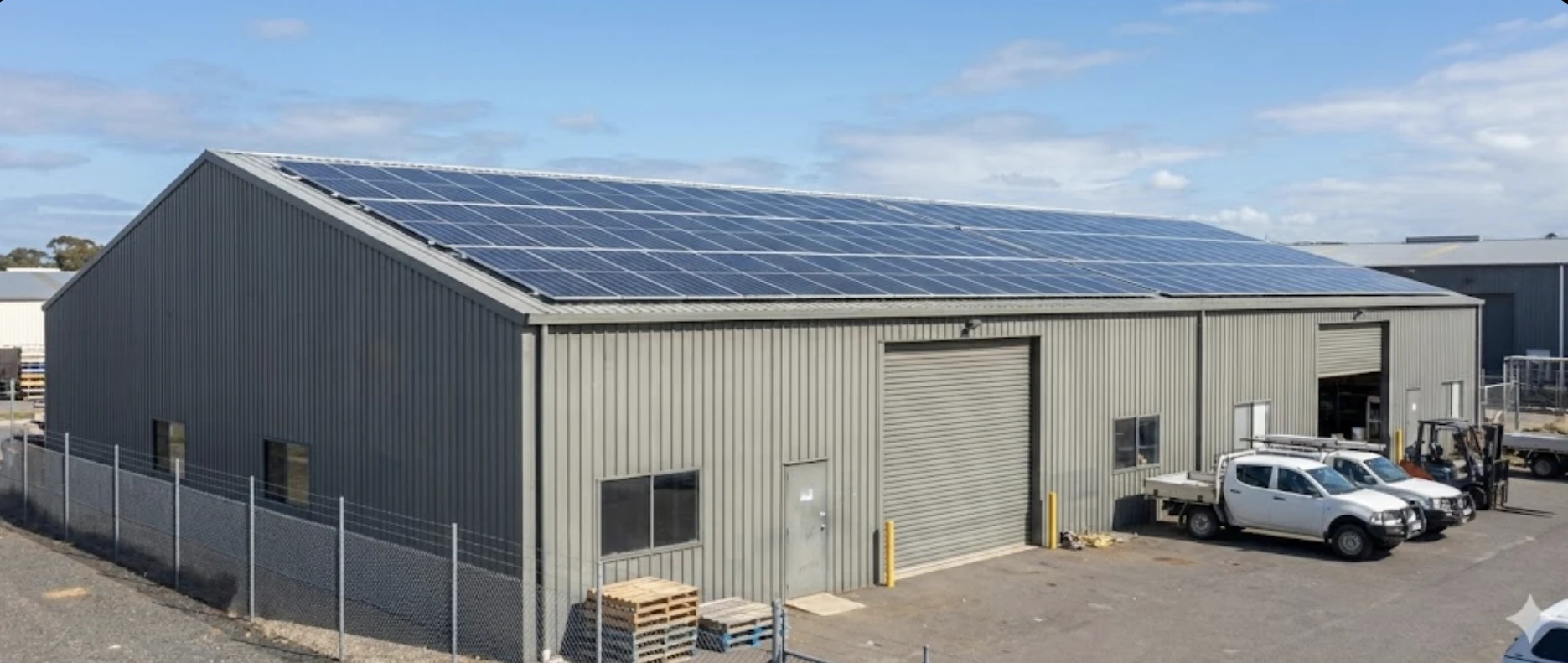
Commercial Solar FAQ
Common Questions
How much does a commercial solar system cost?
Commercial pricing depends on system size, roof type, switchboard and metering, and how the job is delivered. We work on an EPC (engineer, procure, construct) basis and provide a fully itemised proposal after assessing your site and interval data, rather than a headline per-kW figure that hides the real scope.
What is the payback period for commercial solar?
Because most businesses use the bulk of their power during daylight hours, exactly when solar generates, commercial systems often pay back faster than residential ones and then keep producing for decades. The exact payback depends on your usage profile, tariff and available STC and LGC incentives, so we model the numbers for your business up front rather than quote a one-size-fits-all figure.
What size solar system does my business need?
It comes down to your daytime load and available roof or ground space, not a rule of thumb. We size commercial systems from your actual interval (smart meter) data so the array matches what you consume. Typical SME systems range from 30 to 100 kW, though a warehouse, factory or cold-storage site may justify more.
How do LGCs work for commercial solar?
Systems above the small-scale threshold generate Large-scale Generation Certificates (LGCs) rather than the upfront STCs. That threshold is 100 kW today and is set to rise to 1 MW for systems installed from 1 October 2026, subject to regulations. LGCs are created for the energy your system actually produces each year and can be sold or traded, providing an ongoing return on top of your bill savings. We explain which scheme applies to your system and factor it into your financial case. See the full commercial rebates guide.
Do you manage the grid connection and approvals?
Yes. Commercial connections involve your DNSP (distribution network provider), and larger or three-phase systems need pre-approval before install. We coordinate the DNSP application, compliance and metering as part of EPC delivery, and schedule the work around your operating hours to minimise disruption.