Residential Battery Systems in Geelong & Surrounds
Geelong and surrounds


Why Add a Battery
Stop Giving Your
Solar Away
for 1 Cent
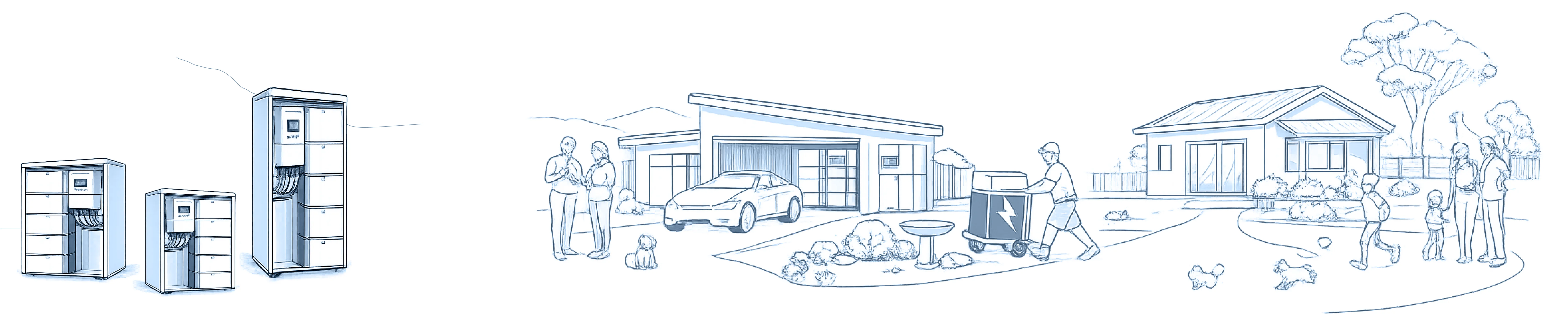
Without a battery, your solar panels export excess electricity to the grid during the day. The feed in tariff you get paid for that? It's barely one cent per kilowatt hour! Then at night, when you're cooking dinner, charging the car, or running the heater, you buy power back from the grid at 30 cents or more.
A battery changes that equation completely. Instead of sending your solar to the grid for next to nothing, you store it. Then at night, your home draws from the battery first. Your electric vehicle charges from the battery. Your induction cooktop runs from the battery. Your heater runs from the battery.
The result is simple: you use more of your own solar, buy less from the grid, and get a much better return on every panel on your roof.
How It Works
Where Your Energy Goes
Solar generates
Panels produce electricity during the day.
Home uses first
Everything running in your home gets powered first.
Battery stores the rest
Excess solar charges the battery for tonight.
Grid gets the leftovers
Only once the battery is full does anything go to the grid.
With Every Battery System
What We're Known For

independence
monitoring
warranty

lifespan



Battery Sizes
What Size Battery Do You Need?
12 kWh BatteryA solid starting point for most homes. Covers evening peak usage and takes the edge off overnight grid imports. Best for: Couples & smaller households | Most Common 24 kWh BatteryThe most common size for a family home. Covers most overnight consumption including EV charging and induction cooking. Best for: Family homes | 48 kWh BatteryFor larger homes or those targeting near-complete grid independence. Ideal when paired with a bigger solar system. Best for: Large homes & full independence | |
|---|---|---|---|
| Feature | 12 kWh Battery | 24 kWh Battery | 48 kWh Battery |
| Usable Capacity | ~11-12 kWh | ~22-24 kWh | ~45-48 kWh |
| Evening Coverage | 6-10 hours | 12-18 hours | 24+ hours |
| Grid Independence | 60-75% | 75-90% | 85-95%+ |
| Chemistry | LiFePO4 | LiFePO4 | LiFePO4 |
| Ideal Solar Pairing | 6.6-10 kW array | 10-15 kW array | 15-20 kW array |
| Backup Capability | Essential circuits | Most of home | Whole home possible |
| Warranty | 10 years | 10 years | 10 years |
| VPP Compatible | Yes | Yes, ideal | Yes, maximum earnings |
12 kWh Battery
A solid starting point for most homes. Covers evening peak usage and takes the edge off overnight grid imports.
Best for: Couples & smaller households- Usable Capacity
- ~11-12 kWh
- Evening Coverage
- 6-10 hours
- Grid Independence
- 60-75%
- Chemistry
- LiFePO4
- Ideal Solar Pairing
- 6.6-10 kW array
- Backup Capability
- Essential circuits
- Warranty
- 10 years
- VPP Compatible
- Yes
24 kWh Battery
The most common size for a family home. Covers most overnight consumption including EV charging and induction cooking.
Best for: Family homes- Usable Capacity
- ~22-24 kWh
- Evening Coverage
- 12-18 hours
- Grid Independence
- 75-90%
- Chemistry
- LiFePO4
- Ideal Solar Pairing
- 10-15 kW array
- Backup Capability
- Most of home
- Warranty
- 10 years
- VPP Compatible
- Yes, ideal
48 kWh Battery
For larger homes or those targeting near-complete grid independence. Ideal when paired with a bigger solar system.
Best for: Large homes & full independence- Usable Capacity
- ~45-48 kWh
- Evening Coverage
- 24+ hours
- Grid Independence
- 85-95%+
- Chemistry
- LiFePO4
- Ideal Solar Pairing
- 15-20 kW array
- Backup Capability
- Whole home possible
- Warranty
- 10 years
- VPP Compatible
- Yes, maximum earnings
Back-to-Base Monitoring
We'll Know Something Is Wrong Before You Do
Every system we install is connected to our back-to-base monitoring portal. Our team checks every system each morning. If something drops out, generates less than expected, or throws a fault, we see it, often before the homeowner even notices.
We've had cases where a system was intermittently disconnecting due to a Wi-Fi issue. We picked it up in our morning check, texted the client, went around and fixed it in five minutes. They had no idea anything was wrong. That's the level of ongoing support we provide.
It's not just install and walk away. We set up monitoring on the day of installation, walk you through the app, and keep an eye on your system from that point forward.
Critical fault response. If our monitoring detects a serious issue with your system, we arrange for one of our A-grade electricians to be on site within 48 business hours. We haven't encountered a critical fault yet, but the commitment is there.
Make It Work for Your Budget
Your electricity bill is already the repayment
If you're spending $300-$400 a month on electricity, the repayments on a solar and battery system can be similar, or less. The difference is where your money goes.
- Pays someone else's asset
- Goes up every year
- Adds no value to your home
- Builds an asset you own
- Fixed repayments, no surprises
- Adds value to your property
Rebates and Incentives
Victorian Battery Rebate
The Victorian Government offers a rebate on home battery installations through the Solar Victoria program. Eligibility depends on your property type, household income, and whether you already have solar installed.
Federal incentives through Small-scale Technology Certificates (STCs) also reduce the upfront cost of qualifying systems.
As a Solar Victoria approved retailer, we handle both the state and federal rebate applications as part of your installation. You don't need to apply separately.
Get a Free Solar Quote
What Affects the Cost
Battery Pricing Factors
Capacity
Larger batteries store more energy but cost more. The right size depends on how much power your household uses and how much solar you generate. We size it using your actual half-hour usage data, not guesswork.
Chemistry
We install lithium iron phosphate (LiFePO4) batteries from Sigenergy, Atmoce, and Tesla. They cost more upfront but last significantly longer and are safer than other lithium chemistries. All three brands use LFP cells rated for 6,000+ charge cycles.
New system vs retrofit
Installing a battery alongside a new solar system is more cost effective than adding one to an existing setup. Sigenergy hybrid inverters support direct battery connection. If you have an older string inverter, an AC-coupled solution like the Atmoce M-ELV can be added without replacing your existing equipment.
Backup capability
Want your battery to keep the lights on during a blackout? That's absolutely possible, but it needs to be set up for it. Full home backup requires additional switchgear, which adds to the cost. We'll walk you through the options.
Data Driven Design
We Size Your Battery From Actual Data, Not Guesswork
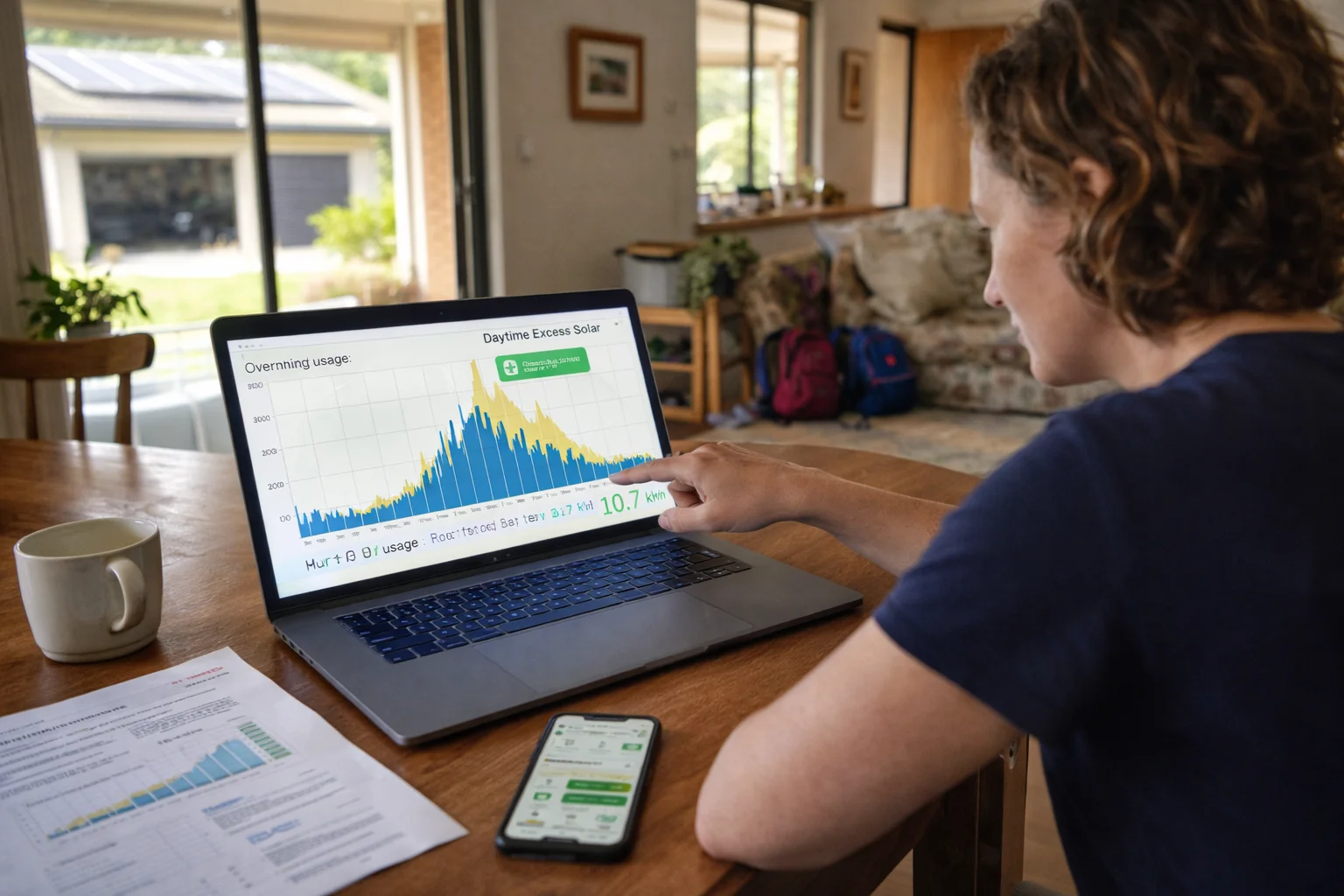
Every property in Australia has a National Meter Identifier (NMI). Using your NMI and smart meter number, we can see your electricity consumption down to half-hour intervals. We can see exactly when you're using power, how much, and how much your existing solar system is generating.
This is how we size your battery accurately. We look at your overnight consumption, your daytime solar excess, and your peak usage patterns to recommend the right capacity. Not from a bill total. Not from a generic calculator. From your actual data.
We don't know any other company in the area that does this level of analysis.
Honest Advice
We'll Tell You If a Battery Doesn't Make Sense
If 90% of your power is being used during the day and you don't have significant nighttime consumption, a battery might not be worth it for you right now. If your solar system is undersized, adding a battery won't fix the underlying issue.
We will tell you this. We'd rather lose a sale than install a system that doesn't perform and have an unhappy customer. That's been our approach from day one, and it's why our clients refer their friends and family.
of solar installations in Australia are substandard, according to the Clean Energy Regulator's audit of 2,500 homes in 2024/25. That's nearly one in five.
We've never had a system made defunct by an electrical inspector. Every install adheres to AS/NZS 4777 standards. Our 10-year workmanship warranty is double the legal minimum of five years, and unlike companies offering 30-year warranties after being in business for one or two years, we've been operating in the Geelong region for over a decade. It's an honest warranty from a company that will actually be here to honour it.
Read the Clean Energy Regulator report →How It Works
From Enquiry to Energy Independence
A quick five to ten minute call to understand your situation: what solar you have, how much you're exporting, and whether a battery makes sense for your home.
We visit your property, review your energy data using your NMI and smart meter, assess your existing solar setup, and discuss your goals.
We design the right battery solution based on your overnight consumption, solar generation, and any future plans like EV charging or heat pumps.
We handle rebate applications, export pre-approval from your local network provider (DNSP), grid connection approval, and permits. Stock is ordered and your installation date is confirmed.
We confirm everything 24 hours before your install: where the battery and inverter will go, how long the power will be off, and what to expect on the day.
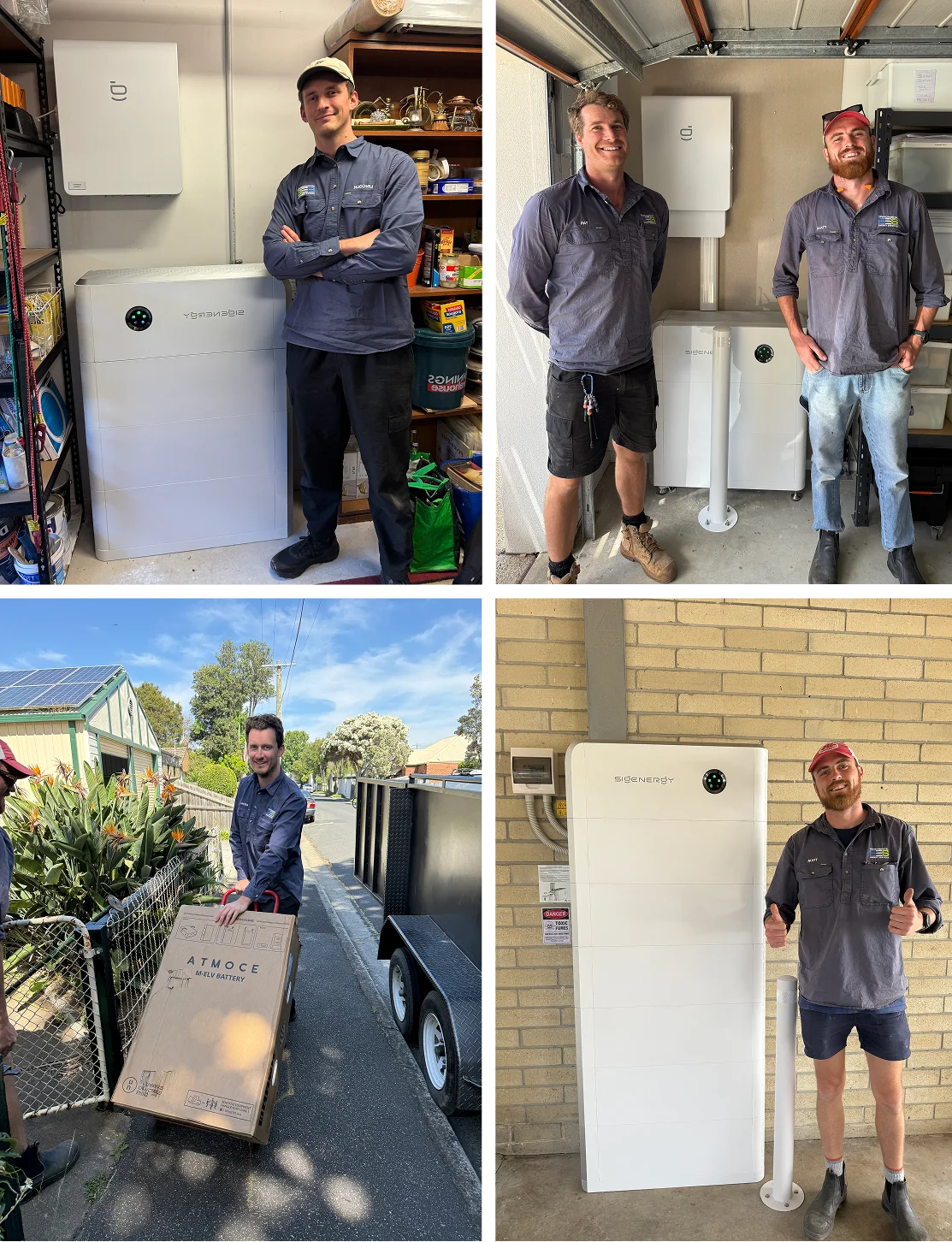
Our CEC accredited team arrives on time and introduces themselves. The battery is installed, commissioned, and the site is cleaned and returned to its original state.
We walk you through how the system works, set up the monitoring app on your phone, and connect your system to our back-to-base monitoring portal so we can keep an eye on it from day one.
We lodge the Certificate of Electrical Safety, an inspector attends your site, DNSP paperwork is completed, your meter is updated, and we help set you up with a VPP or dynamic tariff if applicable.

Warranty & Support
We Stand Behind Every Install
Every installation comes with our 10-year workmanship warranty, covering the installation itself, not just the products. If something goes wrong with how the system was installed, we fix it.
Battery manufacturer warranties typically cover 10 years or a set number of cycles. We're a local team based in Moolap, here for the long term, not a fly-in-fly-out installer.
Battery Storage FAQ
Common Questions
How long do solar batteries last?
Most home batteries are warranted for 10 years or a set number of charge cycles, whichever comes first. With the right install in a suitable, protected location, a quality lithium battery will continue operating well beyond the warranty period with gradual capacity reduction over time.
What size battery do I need?
This depends on your overnight energy consumption, your solar system size, and whether you plan to use a VPP. For homes still on gas, a 10 to 24 kWh battery is typically sufficient. For fully electric homes, 24 to 48 kWh is more appropriate. We size your battery based on your actual energy data from your smart meter, not a generic estimate.
Is it worth getting battery storage with solar panels?
If your feed in tariff is low (and most are now under 5 cents), a battery lets you use your own solar instead of exporting it for next to nothing. Combined with Victorian battery rebates and the option to earn through a VPP, the payback period has shortened significantly in the last few years.
Can you add battery storage to existing solar panels?
Yes. If you have a hybrid inverter, adding a battery is straightforward. If you have a standard string inverter, our team will review whether an AC-coupled battery solution is suitable. An AC-coupled battery does not directly have solar panels connected to it. It can be installed alongside a normal solar inverter that isn't a hybrid. Alternatively, your inverter may need to be upgraded to a hybrid model. We assess your existing system during the consultation and let you know exactly what is needed.
